Ingredients Matter
The cannabis plant has special properties
Cannabis can soak up pollution from air, soil and water.1-3 People use it to help clean up dirty places.4-6
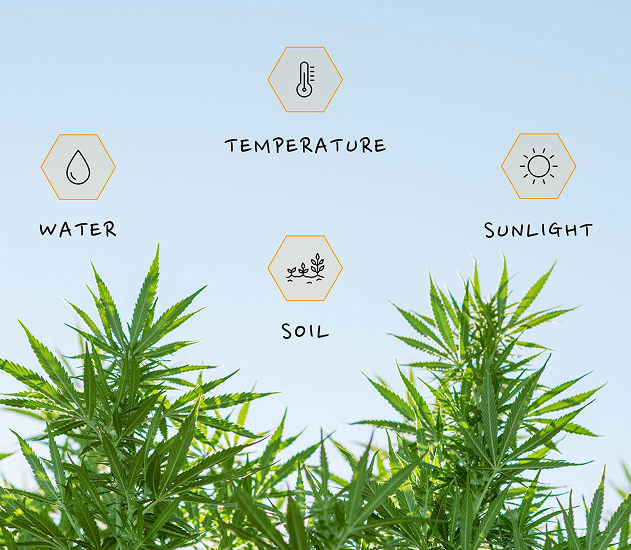
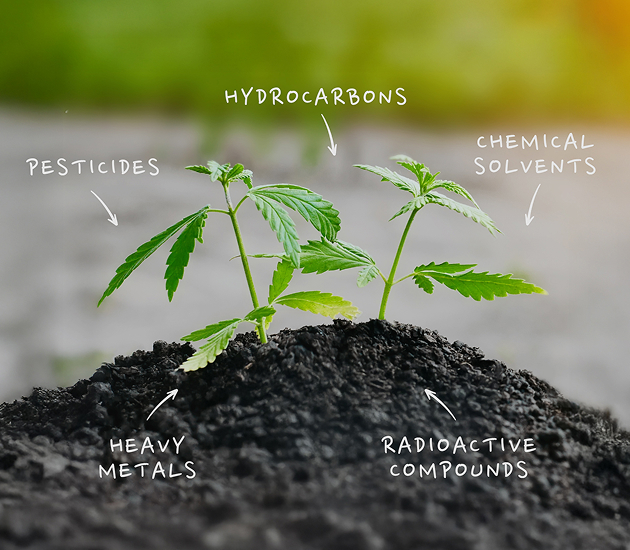
Other things make the plant more complicated
The way cannabis is grown affects what kinds of cannabinoids (molecules) are in the plant.7
Strict rules help make sure FDA-approved medicines are safe and high quality
Cannabis can soak up pollution, and the cannabinoids can change in the plant.2,7 That’s why strict rules are needed to keep products safe and consistent. FDA-approved medicines follow these rules, but many CBD products don’t.8
Strict rules to follow when making medicine from cannabis


Over a decade of research, scientists have
found CBD products to be unreliable.
There are problems with under-regulated CBD products. Buyers should be cautious.
inaccurately labeled Vandrey et al. JAMA.14
THC Bonn-Miller et al. JAMA.15
* Dubrow et al. J Food Compost Anal.16
Why do high standards matter?
Below are side-by-side comparisons between FDA-approved medicine and under-regulated CBD products

FDA-Approved CBD
The label on the package MUST match the contents.21-23
This means there is quality control ensuring consistent concentrations of CBD with every batch.

Under-Regulated CBD Products
(Non–FDA-Approved)
Research shows that many under-regulated CBD products are mislabeled.14, 18, 20
This means you don't know how much CBD there is.
FDA-Approved CBD
Clinical trial research shows how much CBD to take and what to expect when taking it.11,24
This means the Healthcare Provider can properly advise you on dosing you and watch for adverse effects.
Under-Regulated CBD Products
(Non–FDA-Approved)
Without clinical trial data on these products, we don't know if it will work for medical conditions.
This means the Healthcare Provider doesn't have the correct information to advise on how to safely take the product.
FDA-Approved CBD
Manufacturing follows strict GxP and the contents must be free from contaminants.12
This means you have purified CBD that is free from contaminant.
Under-Regulated CBD Products
(Non–FDA-Approved)
Research shows that many under-regulated CBD products can be contaminated.19, 20
This means these products may contain unwanted cannabinoids, like THC, and may be contaminated with toxic elements, like heavy metals or prescribed.
FDA-Approved CBD
FDA approval is required before a drug can be marketed or prescribed.25-26
This means it can become available by prescription from your HCP and may be eligible for coverage by medical insurance.
Under-Regulated CBD Products
(Non–FDA-Approved)
Without FDA-approval the CBD product cannot be prescribed and is not eligible for insurance coverage.25-26
This means it is just another product on the shelf.

Be careful with under-regulated CBD products For your family’s health and safety, ingredients matter.
References
1. Rheay HT, Omondi EC, Brewer CE. Potential of hemp (Cannabis sativa L.) for paired phytoremediation and bioenergy production. GCB Bioenergy. 2020;13(4):525-536. doi:10.1111/gcbb.12782
2. Husain R, Weeden H, Bogush D, et al. Enhanced tolerance of industrial hemp (Cannabis sativa L.) plants on abandoned mine land soil leads to overexpression of cannabinoids. PLoS One. 2019;14(8):e0221570. doi:10.1371/journal.pone.0221570
3. Jurga A, Rodziewicz T, Grzegorzek M, et al. Harnessing Cannabis sativa L. for integrated environmental remediation and circular biomass use. Sci Total Environ. Aug 25 2025;992:179976. doi:10.1016/j.scitotenv.2025.179976
4. Placido DF, Lee CC. Potential of Industrial Hemp for Phytoremediation of Heavy Metals. Plants (Basel). Feb 23 2022;11(5)doi:10.3390/plants11050595
5. Flajsman M, Kosmelj K, Grcman H, Acko DK, Zupan M. Industrial hemp (Cannabis sativa L.)-a valuable alternative crop for growing in agricultural soils contaminated with heavy metals. Environ Sci Pollut Res Int. Nov 2023;30(54):115414-115429. doi:10.1007/s11356-023-30474-z
6. Canu M, Mulè P, Spanu E, Fanni S, Marrone A, Carboni G. Hemp Cultivation in Soils Polluted by Cd, Pb and Zn in the Mediterranean Area: Sites Characterization and Phytoremediation in Real Scale Settlement. Applied Sciences. 2022;12(7):3548. doi:10.3390/app12073548
7. Micalizzi G, Vento F, Alibrando F, Donnarumma D, Dugo P, Mondello L. Cannabis Sativa L.: a comprehensive review on the analytical methodologies for cannabinoids and terpenes characterization. J Chromatogr A. Jan 25 2021;1637:461864. doi:10.1016/j.chroma.2020.461864
8. Federal Register. (2000) Administrative practices and procedures; good guideance practices. https://www.govinfo.gov/content/pkg/FR-2000-09-19/pdf/00-23887.pdf
9. World Health Organization. WHO Guidelines on good agricultural and collection practices (GACP) for medicinal plants. Geneva2003.
10. Organisation for Economic Co-operation and Development. OECD Principles of good laboratory practice. France1998.
11. US Food and Drug Administration. Good Clinical Practice. Updated Oct 11, 2024. Accessed Oct 1, 2025. https://www.fda.gov/about-fda/center-drug-evaluation-and-research-cder/good-clinical-practice
12. US Food and Drug Administration. Facts about the current good manufacturing practice (GMP). Updated Jan 21, 2025. Accessed Oct 1, 2025. https://www.fda.gov/drugs/pharmaceutical-quality-resources/facts-about-current-good-manufacturing-practice-cgmp?_hsenc=p2ANqtz-_wTgMtFtJF4kYYDOPhT8Ax38FIGfL0LlnLicV-4mAemmVQLk0imQOROhBLPVuopItev0My
13. US Food and Drug Administration. Proposed rule: national standards for the licensure of wholesale drug distributors and third-party logistics providers. Updated April 13, 2022. Accessed Oct 1, 2025. https://www.fda.gov/drugs/fdas-labeling-resources-human-prescription-drugs/prescribing-information-resources
14. Vandrey R, Raber JC, Raber ME, Douglass B, Miller C, Bonn-Miller MO. Cannabinoid Dose and Label Accuracy in Edible Medical Cannabis Products. JAMA. Jun 23-30 2015;313(24):2491-3. doi:10.1001/jama.2015.6613
15. Bonn-Miller MO, Loflin MJE, Thomas BF, Marcu JP, Hyke T, Vandrey R. Labeling Accuracy of Cannabidiol Extracts Sold Online. JAMA. Nov 7 2017;318(17):1708-1709. doi:10.1001/jama.2017.11909
16. Dubrow GA, Pawar RS, Srigley C, et al. A survey of cannabinoids and toxic elements in hemp-derived products from the United States marketplace. J Food Compost Anal. Jan 7 2021;97doi:10.1016/j.jfca.2020.103800
17. Gardener H, Wallin C, Bowen J. Heavy metal and phthalate contamination and labeling integrity in a large sample of US commercially available cannabidiol (CBD) products. Sci Total Environ. Dec 10 2022;851(Pt 1):158110. doi:10.1016/j.scitotenv.2022.158110
18. Spindle TR, Sholler DJ, Cone EJ, et al. Cannabinoid Content and Label Accuracy of Hemp-Derived Topical Products Available Online and at National Retail Stores. JAMA Netw Open. Jul 1 2022;5(7):e2223019. doi:10.1001/jamanetworkopen.2022.23019
19. Johnson E, Kilgore M, Babalonis S. Cannabidiol (CBD) product contamination: Quantitative analysis of Delta(9)-tetrahydrocannabinol (Delta(9)-THC) concentrations found in commercially available CBD products. Drug Alcohol Depend. Aug 1 2022;237:109522. doi:10.1016/j.drugalcdep.2022.109522
20. Gidal BE, Vandrey R, Wallin C, et al. Product labeling accuracy and contamination analysis of commercially available cannabidiol product samples. Front Pharmacol. 2024;15:1335441. doi:10.3389/fphar.2024.1335441
21. US Food and Drug Administration. (2025) 21 CFR 201.51 Declaration of net quantity of components. https://www.ecfr.gov/current/title-21/chapter-I/subchapter-C/part-201/subpart-B/section-201.51
22. US Food and Drug Administration. (2025) 21 CFR Part 211 Current good manufactoring practice for finished pharmaceuticals. https://www.ecfr.gov/current/title-21/chapter-I/subchapter-C/part-211
23. US Food and Drug Administration. Botanical Drug Development: Guidance for Industry. FDA.gov. Updated Aug 29, 2024, Accessed Sep 17, 2024. https://www.fda.gov/about-fda/center-drug-evaluation-and-research-cder/what-botanical-drug
24. US Food and Drug Administration. Frequently asked questions about labeling for prescription medicines. Updated Jan 21, 2025. Accessed Oct 1, 2025. https://www.fda.gov/drugs/fdas-labeling-resources-human-prescription-drugs/frequently-asked-questions-about-labeling-prescription-medicines
25. US Food and Drug Administration. (2025) 21 CFR Part 310 §355 New Drugs. https://www.govinfo.gov/content/pkg/USCODE-2024-title21/pdf/USCODE-2024-title21-chap9-subchapV-partA-sec355.pdf
26. US Food and Drug Administration. Overview of our role regulating and approving drugs | video series. Updated Nov 26, 2024. Accessed Dec 17, 2025. https://www.fda.gov/drugs/information-consumers-and-patients-drugs/overview-our-role-regulating-and-approving-drugs-video-series